Ask the average Westerner what Hebrew looks like, and they would probably imagine something like this:

Ask the average native Hebrew speaker, and they would probably imagine much the same — but perhaps in a more modern, more subtly serifed, or a non-serif font:

Some might cite an example of modern Hebrew cursive writing, which is far less familiar to people outside Israel:

— or lesser-known traditional varieties, such as Rashi Script, which is often used in Talmudic commentary:

Some might know of other varieties of Hebrew script over the centuries, such as the cursive script among Sephardi Jews in the Arab empire in the late Middle Ages, which not surprisingly was influenced by the Arabic script:
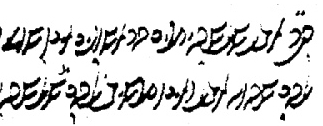
(courtesy of the Bodleian Library, Oxford)
— or the Gothic-like cursive among Ashkenazi Jews at the same period:
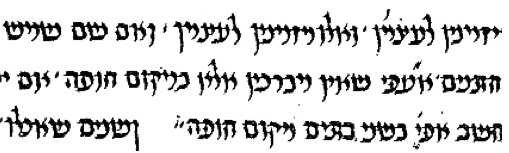
(courtesy of the Bodleian Library, Oxford)
Someone more versed in the history of Hebrew script might point out that the original Hebrew script — which was common to all Canaanite nations, including Israel and Judah, right up to the end of the First Temple period in 586 BCE, and served as the basis for the Greek alphabet, which begat the Roman one — could also be used:

But it's only when you see the same text in Hebrew Morse code:

— or in Hebrew Braille:

— that one starts to appreciate that Hebrew is first and foremost a language, rather than a unique script — and that Hebrew characters can vary enormously in their graphic appearance and still retain the integrity of the language. In other words, as long as you designate that a particular sign means א, another stands for ב, another stands for ג, and so forth, for all letters of the Hebrew aleph-bet (alphabet) — any collection of signs can be used to represent Hebrew.
With this insight in mind, it is easy to see how Hebrew script can easily be simulated in any character set — as long as you maintain a strict one-to-one mapping (and preferably, one that is comparatively easy to relate to the familiar Square Hebrew).
One such mapping is the following:
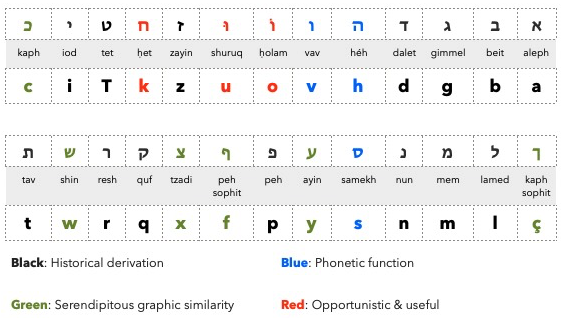
The ramifications of such simulated Hebrew in Roman characters — or SimHebrew™, for short — are tremendous, as the use of traditional Square Hebrew is impossible, limited, or buggy in many computer applications and other electronic contexts. Using SimHebrew makes it possible to convey Hebrew in any computerised or electronic environment that supports standard ASCII (i.e., the English alphabet). The sample one-line text above, for example, would look like this in SimHebrew:
dg sqrn wT bim mauczb, ulpty mxa kbrh
— and the first five verses of the Book of Genesis would look as follows:
a brawit bra alohim at hwmiim vat harx.
b vharx hiith tohu vbohu vkowç yl-pni thom; vruk alohim mrkpt yl-pni hmim.
g viamr alohim ihi aor; vihi-aor.
d vira alohim at-haor ci-Tob; vibdl alohim bin haor ubin hkowç.
h viqra alohim laor iom vlkowç qra lilh; vihi-yrb vihi-boqr iom akd. {p}
Reading or writing SimHebrew takes a little practice — whether your native language is Hebrew or English, you need to train your mind to remember that the characters should not be read as in English (just as it knows not to pronounce Champs Élysées as "champs eleezees"), but as the Hebrew characters that they represent. However, this task is made easier by the fact that it is graphically not unlike a mirror version of standard Square Hebrew — as evident when you flip any SimHebrew text horizontally:

However, the purpose of SimHebrew is not to replace Square Hebrew where Square Hebrew is readily available and works well, but to store or convey Hebrew information where Square Hebrew is not possible, or tends to go wrong. Accordingly, a key part of the SimHebrew scheme is the computerised converter, that can convert electronic Square Hebrew text into SimHebrew — and back — with full fidelity. Click the button below to try it.